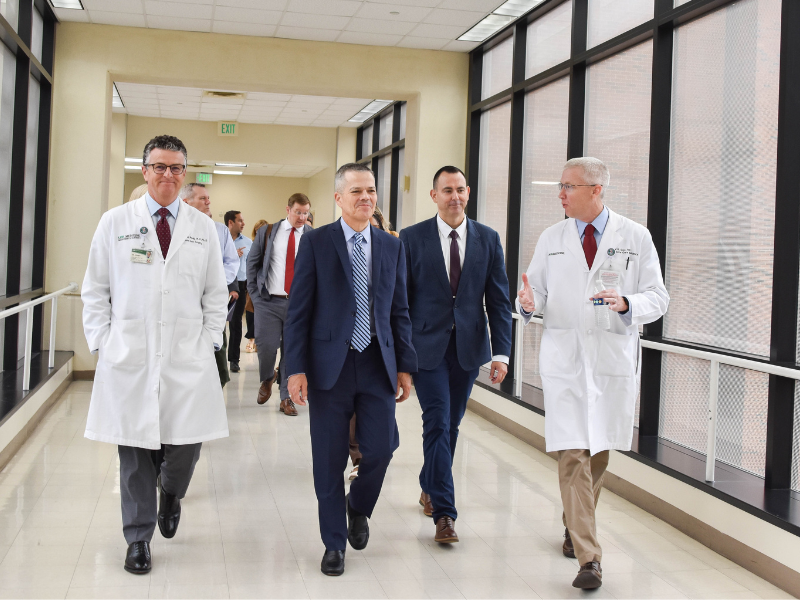
 Left to right: Dr. Jeffrey Kerby, Lt. Gen. John DeGoes, Chief Master Sgt. James Woods, and Dr. Daniel Cox on a tour of UAB Hospital.
The University of Alabama at Birmingham Division of Trauma and Acute Care Surgery welcomed Lt. Gen. John. J. DeGoes, Surgeon General of the United States Air Force and U.S. Space Force, and Chief Master Sgt. James M. Woods, Chief of the Medical Enlisted Force, for a visit to see firsthand the growth and success of the military-civilian partnership between UAB and the U.S. Air Force.
Since 2006, UAB has provided robust medical readiness training for Air Force personnel. The partnership, known colloquially as a “mil-civ” partnership, now includes multiple embedded Special Operations Surgical Teams and a two-week clinical training program each year, hosting hundreds of Air Force special and sister component operations medics, and has grown from 50 trainees when the program began at UAB in 2006).
To show the fruits of 20 years of maturation of the partnership, UAB hosted DeGoes and other Air Force leaders to share lessons learned and opportunities for future growth.
DeGoes, who is also the commander of the Air Force Medical Command, advises top military leaders within the Air Force and Space Force on the development of a medically ready force, guiding the $6.1 billion, 44,000-person integrated healthcare delivery and readiness system at 76 military treatment facilities worldwide. He provides direct command for 27,000 uniformed medical personnel and supports the $42 billion Defense Health Program portfolio. As such, DeGoes is interested in how more personnel can become better prepared to save lives during dangerous deployments.
Daniel Cox, M.D., is the UAB Trauma Medical Director and is a colonel in the U.S. Air Force, serving as the senior medical advisor to the Air Force Special Operations Command Surgeon. Cox led the visit from the UAB side and started the day with an overview of the partnership.
“This partnership has built the ‘connective tissue’ between military and civilian trauma care,” Cox said. “With zero cost to the military, we are able to provide unparalleled clinical access to far forward special operations medics, which greatly benefits their ability to provide lifesaving care across the globe.”
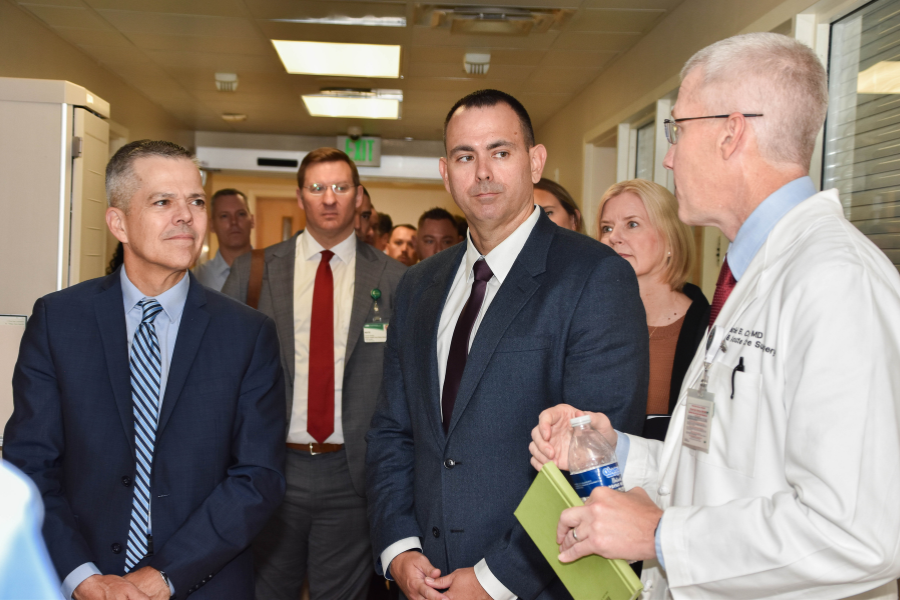 Lt. Gen. John DeGoes, left, and Chief Master Sgt. James Woods, middle, tour UAB Hospital with UAB Trauma Medical Director Dr. Daniel Cox, right.
A mutually beneficial partnership
The mil-civ partnership is mutually beneficial for the Air Force and UAB as a civilian academic medical center.
The Air Force benefits because UAB provides an ideal training ground for special operations medical personnel, medics, and pararescuemen. In-between deployments, these personnel need to remain clinically sharp, and most military training facilities across the country do not handle the number, or severity, of cases to provide robust training in trauma and critical care medicine.
UAB, the fifth largest hospital in the country and an American College of Surgeons-verified Level I Trauma Center evaluating 7,000 trauma patients annually, has ample volume of complex trauma cases to allow Air Force personnel to have hands-on, real-world training.
“Medical training is absolutely critical. We need military-civilian partnerships, like the one at the University of Alabama at Birmingham,” DeGoes said.
UAB benefits by having additional team members for trauma clinical support and being able to be at the forefront of innovation and research. Several trauma medical interventions that are now used widely at civilian hospitals were born out of hard-won, battlefield experience, like the benefits of whole blood and pre-hospital blood.
The UAB Center for Injury Science manages several multicenter clinical trials, like the TROOP trial studying the transfusion efficacy of different types of blood products, and is a member site for Department of War-funded trials such as LITES/TOWAR, which is evaluating prehospital whole blood resuscitation.
The connection to the military means these research-backed treatments can be quickly implemented to benefit civilian patients.
As part of his visit, DeGoes met with UAB Health System leaders including Dawn Bulgarella, MSHA, CPA, CEO of the UAB Health System; Brenda Carlisle, MSHA, RN, CEO of UAB Hospital; Michelle Fortune, MBA, BSN, Executive Vice President of Hospital Operations; Kierstin Kennedy, M.D., MSHA, Chief Medical and Quality Officer of UAB Hospital; and Jeffrey Kerby, M.D., Ph.D., Director of the Division of Trauma and Acute Care Surgery.
“It’s an honor to be in partnership with the United States Air Force to prepare our servicemen and women for their missions,” Carlisle said. “We are proud to help meet strategic national goals in military preparedness by allowing these invaluable clinical touchpoints.”
Special Operations Surgical Teams (SOST)
On his tour of UAB Hospital, DeGoes met with recently deployed SOST team members who shared how their training at UAB prepared them for their duties abroad.
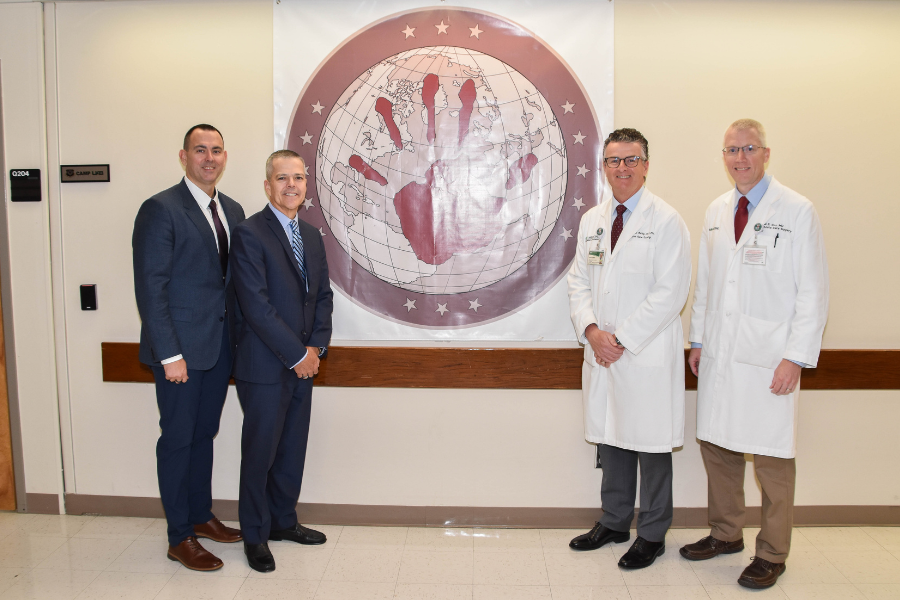 Left to right: Chief Master Sgt. James Woods, Lt. Gen. John DeGoes, Dr. Jeffrey Kerby, and Dr. Daniel Cox outside the SOST office at UAB Hospital.
SOST teams are made up of a surgeon, a nurse, a scrub tech, an emergency medical physician, a respiratory therapist, and an anesthesiologist. The teams need to be ready at a moment’s notice to deploy – and being clinically embedded in the trauma team allows them to do just that.
A notable example: in 2021, a SOST team took a trauma call together and within multiple hours were on their way to Kabul, Afghanistan to save lives during the last days of the war.
The first SOST was embedded at UAB in 2010, and has now grown. The personnel take individual calls, adding additional capability to the trauma team, and also take calls as a team, ensuring they have real world experience working cases together before deploying to austere settings. They benefit from the immense amounts of specialized knowledge at UAB and are able to take lessons learned from neurosurgery, vascular surgery, burn care, and more with them to resource-limited areas where they are working cases with materials they can carry on their backs.
“What UAB can provide is ample opportunity for our military partners to care for severely injured patients right alongside our civilian experts,” Cox said. “They are staying at the top of their game clinically and are able to take the high-quality care we provide at UAB straight to our wounded warriors.”
The Special Operations Center for Medical Integration and Development (SOCMID)
DeGoes and Woods also visited the Special Operations Center for Medical Integration and Development (SOCMID) office to learn about the program that trains hundreds of Air Force Pararescue Specialists and Special Operations Independent Duty Medical Technicians along with other Special Operations Command medics.
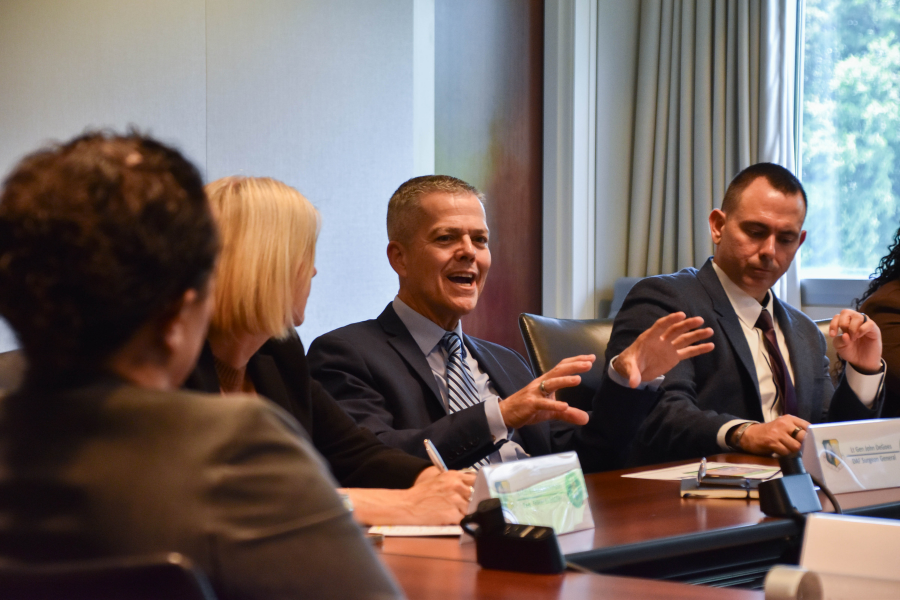 Lt. Gen. John DeGoes, middle, makes final remarks.
The rotational training program had its start at UAB in 2006 and has grown from welcoming around 50 personnel in the early days to being on track to train hundreds by the end of 2026.
These military personnel are “tip of the spear” military personnel, meaning they are the forward-most service members making the closest contact with the enemy or with danger as they provide medical care. They are trained to provide cover and care during active combat.
UAB was able to bridge a gap in Air Force readiness: when in-between deployments, medics have sparse opportunities for keeping the clinical skills in their toolkit sharp.
By creating a program and standardizing training, UAB provides trauma and critical care medical training that goes beyond a typical paramedic recertification course. SOF military medics have rotations in the trauma bay and obtain hands-on experience at a Level I Trauma Center.
“One special thing about UAB is the immense support and buy-in from everyone across the institution,” Cox said. “Our team welcomes embedded and rotating service members into the fold, making sure they get the real-world experiences they need.”
In 2020, the Air Force-UAB partnership was formalized by the Air Force with the creation of SOCMID.
Recognition of successes, preparation for the future
During closing remarks, DeGoes presented challenge coins recognizing a job well done to Cox and Billy Nored, the director of UAB Military Programs. Woods additionally recognized Senior Master Sgt. Benjamin Taylor, the SOCMID Commandant.
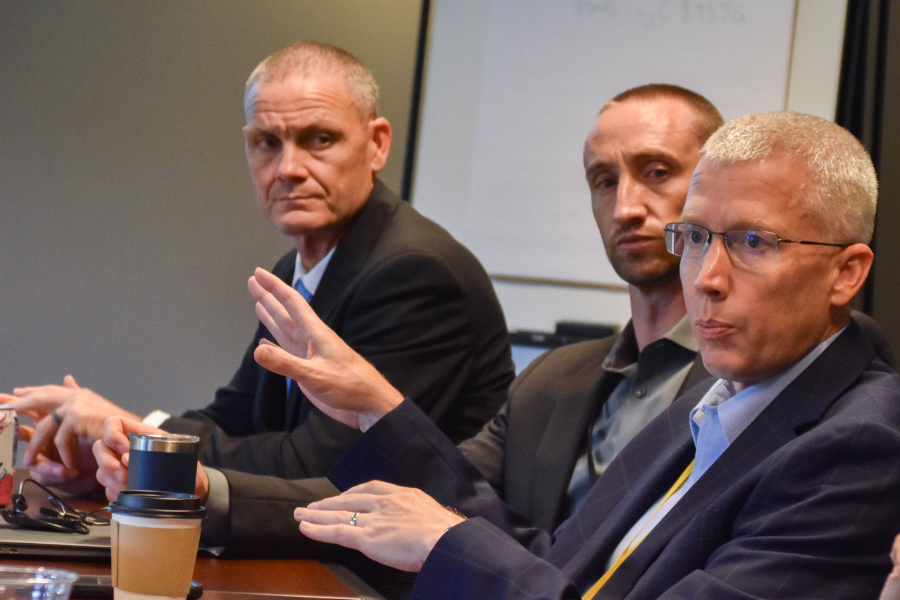 Dr. Daniel Cox, right, makes final remarks.
DeGoes also noted the dedication and commitment of UAB leaders and veterans who have made the partnership a success over the past 20 years, including Director of the Division of Trauma and Acute Care Jeffrey Kerby, M.D., Ph.D., who welcomed the first military team to UAB in 2006.
“One of the commonalities of our successful military-civilian partnership is the leadership of somebody who’s been there, done that, wearing a uniform, and can apply that real-world experience to the clinical excellence that’s in a world-class, very high-volume trauma center like UAB,” DeGoes said. “These folks could go anywhere, and the fact that they choose to come here is a testimony to how the community and the leadership of UAB supports military medicine, and these outstanding former military clinicians who want to continue to give back.”
To learn more about the 2021 mission that a UAB-embedded SOST team completed during the evacuation in Kabul during the last days of the War in Afghanistan, read this story from UAB.