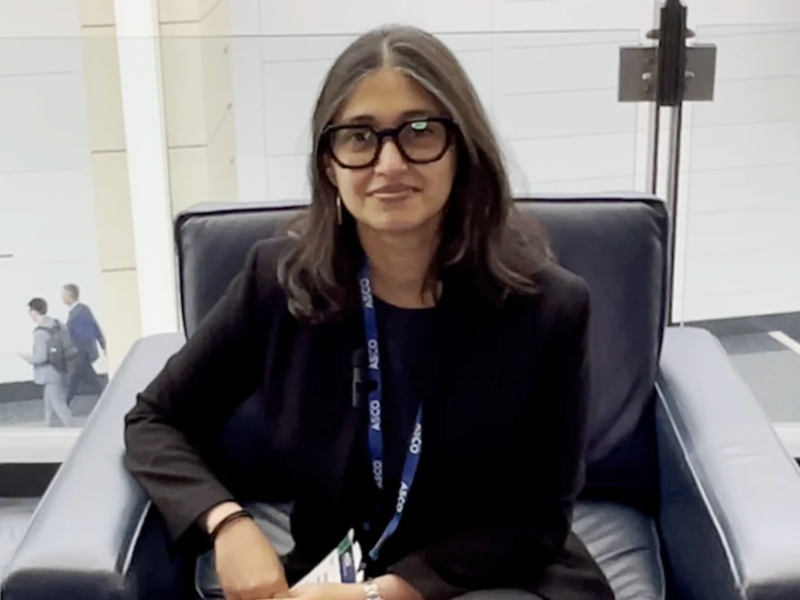
Annabelle Fonseca, M.D., MHS, an associate professor in the UAB Division of Surgical Oncology, is leading research that uses machine learning to identify patients with pancreatic cancer who are at high risk for not receiving guideline-concordant care, the evidence-based treatment associated with the best outcomes. The goal is to identify vulnerable patients early enough for health systems to intervene before treatment opportunities are lost.
Fonseca presented this work at the American Society of Clinical Oncology (ASCO) Annual Meeting, where the study demonstrated how routinely available clinical, socioeconomic and healthcare access factors can be used to identify patients at risk for treatment gaps. She was also interviewed by ASCO AI in Oncology, where she discussed the clinical implications of the work and how artificial intelligence may help improve cancer care delivery.
The research team analyzed routinely available information from the electronic health record (EHR), including demographic, clinical, socioeconomic, and health care access variables collected at the time of oncology presentation. Multiple machine learning approaches including logistic regression, gradient boosting, random forests, and Naïve Bayes were developed and evaluated to determine whether patients were likely to receive guideline-concordant treatment.
Unlike many artificial intelligence (AI) applications in oncology that focus on predicting tumor biology or treatment response, this work uses AI to identify patients at risk for barriers to receiving evidence-based cancer care, creating an opportunity for earlier health system intervention.
The study found that approximately one-third of patients did not receive guideline-concordant treatment. The strongest predictors reflected not only clinical factors but also social vulnerability and health care access, suggesting that failure to receive optimal treatment is often driven by systems-level barriers rather than tumor biology alone. Across multiple machine learning approaches, the models demonstrated the feasibility of prospectively identifying high-risk patients using information already available in the EHR.
Fonseca envisions integrating the prediction model directly into the EHR so that high-risk patients can be automatically identified when they first present for cancer care. This would allow care teams to proactively connect patients with resources such as patient navigation, social work, financial counseling, nutrition support and transportation assistance before delays or barriers compromise treatment.
“We can predict with a reasonable degree of accuracy patients who are not going to receive guideline-concordant treatment at the moment of presentation using data that is available in the chart and that you can get from patients very easily, and that gives us an opportunity to intervene,” Fonseca said in her interview with ASCO AI in Oncology. "But the goal isn't simply to predict who won't receive treatment. The goal is to identify those patients early enough that we can intervene, address the barriers they face and help more patients receive the care most likely to improve their outcomes."
Fonseca leads Fonseca Lab, which is focused on “identifying the modifiable barriers that prevent patients from receiving high-quality, timely, and guideline-concordant treatment for GI cancers, in particular foregut cancers.” The research group is working is to develop targeted strategies to improve access to high-quality cancer care for patients, regardless of their background.