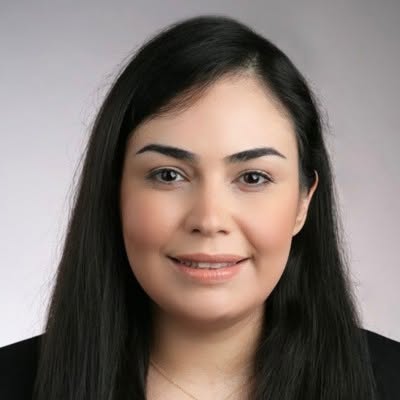
Somayeh Taghizadeh, M.D., joined the Department of Radiation Oncology as an assistant professor in September 2026.
She completed her undergraduate and master’s studies in physics at Shiraz University in Iran, where her graduate studies focused on elementary particle and high-energy physics. After moving to the United States, she earned a second master’s degree in physics, with a focus on biomedical acoustics, at the University of Mississippi’s National Center for Physical Acoustics. She later earned her doctorate in radiation therapy medical physics from the University of Toledo.
Before joining UAB, Taghizadeh completed a therapeutic medical physics residency at Vanderbilt University Medical Center, where she received broad clinical training in radiation oncology. Her experience included treatment planning, stereotactic radiosurgery, stereotactic body radiation therapy, brachytherapy, image-guided radiation therapy, quality assurance, commissioning and radiation safety.
Her academic and research experience spans medical imaging, brachytherapy, lung SBRT, treatment planning and machine learning. Throughout her graduate training and residency, she also taught and mentored students and residents. Collectively, these experiences shaped her interests in clinical medical physics, research and education.
Learn more about her journey and what inspires her work.
What inspired you to pursue a career in this field?
Taghizadeh: I have always enjoyed physics and problem-solving, but I wanted to apply that background in a way that could make a direct impact. Medical physics was a natural fit because it brings together physics, medicine, imaging, technology and patient care.
What I especially enjoy about radiation oncology physics is that the work is both highly technical and clinically meaningful. Whether we are developing a treatment plan, evaluating new technology, performing quality assurance or helping solve a complex clinical problem, the goal is the same: to ensure each patient’s treatment is delivered as safely and accurately as possible. That sense of purpose is what drew me to the field and continues to motivate me.
What is your primary area of expertise within your field, and what sparked your passion for it?
Taghizadeh: My primary area of expertise is therapeutic medical physics, with particular interests in brachytherapy, treatment planning, stereotactic radiosurgery, image guidance, and quality assurance.
What excites me most is the intersection of physics, imaging, computation, and clinical care. I enjoy identifying clinical or technical challenges, understanding the physics behind them, and finding practical ways to evaluate or address them. I am also particularly interested in how emerging computational tools, including machine learning, can be thoughtfully applied to advance radiation oncology and improve patient care.
What aspects of your new role here are you most excited about?
Taghizadeh: I am excited to begin this next stage of my career in an academic environment where I can continue to grow clinically and academically while contributing to patient care and research.
One of the things that attracted me to UAB is the strength of the medical physics faculty and the opportunity to work alongside colleagues with extensive clinical and technical expertise. The group works with cutting-edge technologies and is continually finding innovative ways to improve clinical workflows and solve complex problems. I am particularly interested in the group’s strong technical and computational expertise, including the development of in-house software and coding tools that support and advance clinical practice.
This environment provides an opportunity to learn from my colleagues, broaden my technical skills, and become more involved in developing and implementing new technologies. I look forward to continuing to challenge myself and grow as a medical physicist while also contributing my own experience, perspectives, and ideas to the team.
What are your goals for making an impact through both your teaching and patient care in this role?
Taghizadeh: My goal in patient care is to contribute to safe, accurate, and high-quality radiation therapy while continually looking for ways to improve clinical processes and incorporate new technologies that can meaningfully benefit patients.
As an educator, I hope to be approachable and create an environment where residents and students feel comfortable asking questions, thinking critically, and developing confidence in their clinical reasoning. I was fortunate to have mentors who took the time to teach me not only what we do in medical physics, but also why we do it. I hope to provide that same guidance and support to future trainees.
Ultimately, I want my clinical work, teaching and research to complement one another, using questions that arise in patient care to inspire research and bringing what we learn back to the clinic and classroom.
Anything else you’d like to add?
Taghizadeh: I am very excited to join UAB and become part of the department and the broader UAB community. I am looking forward to learning from my new colleagues, contributing to the department’s clinical and academic missions, building new collaborations, and continuing to grow as a medical physicist, researcher, and educator.