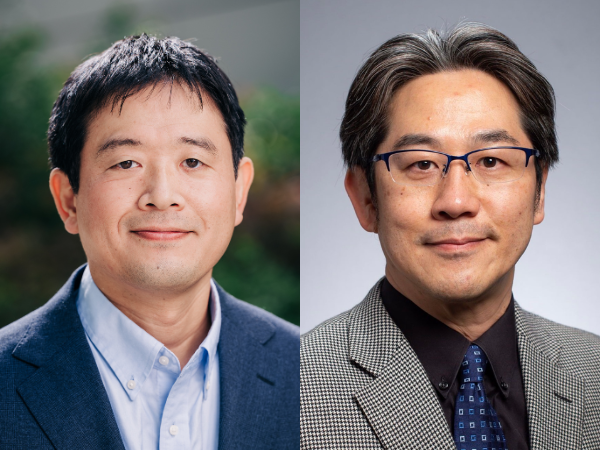
 Satoru Osuka, M.D., Ph.D., (left) and Masakazu Kamata, Ph.D. (right)The University of Alabama at Birmingham Department of Neurosurgery Assistant Professor Satoru Osuka, M.D., Ph.D., and Department of Microbiology Associate Professor Masakazu Kamata, Ph.D., are among the authors of a recent study published in Neuro-Oncology, one of the leading journals in the brain tumor field.
The study, titled “Exploring the immune environment of glioblastoma in humanized mouse models,” reports the development of a next-generation mouse model designed to better investigate human recurrent glioblastoma and support the development of new immunotherapies.
This project was conducted through a close collaboration between Osuka’s research laboratory and Kamata’s research laboratory.
By combining expertise in brain tumor biology, immunotherapy and humanized mouse modeling, the research team created a platform that more accurately reflects the human immune environment seen in recurrent glioblastoma.
Glioblastoma is the most aggressive primary brain tumor in adults, and new treatments are urgently needed. Before a new therapy can be tested in patients, researchers must first evaluate its safety and effectiveness in laboratory models, including mouse models. However, this has been a challenge for immunotherapy research because there are important differences between the mouse and human immune systems. As a result, treatments that appear promising in mice may not always show the same effects in patients.
This gap can be disappointing for patients and families who are waiting for better treatment options. It can also lead to major losses of time, effort, and research funding. To address this problem, the Osuka and Kamata research teams developed an advanced “humanized” mouse model for brain tumor research. In simple terms, this approach replaces much of the mouse immune system with a human immune system.
To create this model, researchers first used mice whose own immune systems were largely removed. They then transplanted human blood-forming stem cells, which are the source of many different immune cells, into the mice. Over time, these cells rebuilt a human immune system inside the mouse. The team then implanted treatment-resistant human glioblastoma cells to study how human brain tumors interact with human immune cells in the mice body.
Humanized mouse models have existed for many years, but earlier versions had important limitations. In particular, they often failed to fully reproduce key immune cell populations, including myeloid cells and regulatory T cells, which play major roles in the immunosuppressive environment of glioblastoma. To overcome this challenge, the team used specialized cytokine knock-in mice that provide signals to help human stem cells develop into a broader range of immune cells.
The study showed that this next-generation model more closely reproduces the immune patterns seen in human recurrent glioblastoma, including important immunosuppressive features of the tumor microenvironment. These findings suggest that the model may serve as a valuable platform for studying brain tumor biology and for testing new immunotherapies in a setting that more closely reflects the human immune system.
“This work, made possible through our collaboration with Dr. Masakazu Kamata and his team in the UAB Department of Microbiology, represents an important step toward building better models for developing more effective therapies for patients with glioblastoma,” said Osuka, the corresponding author of the study and principal investigator of the Osuka research laboratory lab in the Department of Neurosurgery. “We hope this model will help improve the way we evaluate new immunotherapies before they move toward clinical testing.”
The study was led by first author Jun Takei, M.D., Ph.D., together with collaborators across UAB and other institutions, including Department of Neurosurgery Professor Erwin Van Meir, Ph.D. Osuka and Kamata served as corresponding authors of the study. The research team believes this model will be useful not only for glioblastoma research, but potentially also for studying immunotherapy approaches in other cancers.
Researchers, clinicians and collaborators interested in learning more about this model or potential collaborations are encouraged to contact Osuka at