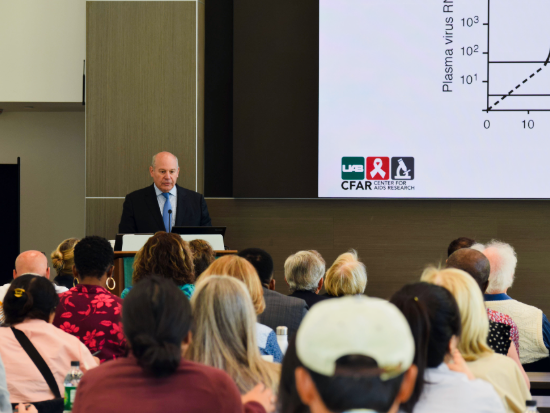
 On Oct. 6, 2026, students, trainees, faculty, and global health partners gathered at the Marnix E. Heersink Conference Center for the 2026 Michael S. Saag, M.D., Lectureship in Global Health, hosted by the Mary Heersink Institute for Global Health. Saag’s reflections on a career defined by scientific innovation, collaboration, and service sparked an afternoon of discovery and dialogue.
A career built on collaboration
What began with a residency in Birmingham in 1981 grew into a career that helped define global health at UAB. Michael S. Saag, M.D., founded the UAB 1917 Clinic, led the UAB Center for AIDS Research, and served as the Heersink School of Medicine’s associate dean for Global Health. In his lecture, he traced that career path through the major scientific projects, ideas, and partnerships that shaped it.
For Maria Netto, M.D., postdoctoral research fellow in the UAB Department of Surgery and current student in the Master of Science in Global Health (MSGH) program, Saag’s message was especially resonant.
“Hearing him reflect on his career through major scientific projects, innovative ideas, and meaningful collaborations was a powerful reminder that impactful work in medicine and global health is rarely accomplished alone,” said Netto. “What stood out to me most was how his career has consistently combined scientific innovation, collaboration, and a genuine commitment to making a difference in people's lives.”
For Ellie Gorman, a medical student in the Recognition of Distinction in Global Health program, those themes struck a personal chord. Born and raised in Birmingham, she has followed Saag’s career for years and said it was an honor to hear firsthand how advocacy, resourcefulness, and dignity for all patients have guided his global health work.
“As a student hoping to match into a pediatrics residency next year, he reinforced how the best medicine is often grounded in building trust within a community and honoring their unique culture(s), requiring a commitment to humble leadership,” said Gorman. “I am equally inspired by his call to stand by vulnerable populations, evidence-based medicine, and time-honored international partnerships amidst our evolving global health landscape.”
Research without borders
Following the lecture, students and trainees presented their work during a poster session in the conference center lobby. Saag and a panel of judges, whose work spans Eswatini, Zimbabwe, South Africa, and many other settings, reviewed the posters, and prizes were awarded in the top categories.
For Matt Heimann, M.D., associate director for Educational Programs for the Mary Heersink Institute for Global Health, the move from lecture hall to lobby revealed as much about the institute as the lecture itself.
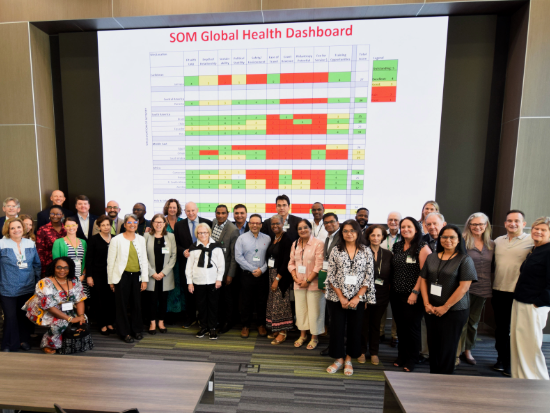 “As the diverse crowd of attendees from the Saag Lecture filed out of the conference hall and naturally flowed out into a packed lobby of student/trainee global health posters and international colleagues networking through a coffee and tea hour, I saw the embodiment of our mission and vision as an Institute,” said Heimann.
Madhushree Zope, an MSGH graduate and current participant in the Global Health Honors Program, found that same spirit throughout the poster session, pointing to the range of disciplines on display as one of the event’s greatest strengths.
“It was great to see various disciplines of global health research represented on the local campus,” said Zope. “We rarely get forums in which trainees from all fields and levels can intermingle; having a dedicated event to showcase research is excellent for the community.”
Many paths, one global mission
The students and trainees who presented their work represent several UAB programs that provide structured opportunities to engage in global health.
The Master of Science in Global Health (MSGH), offered jointly by the Heersink School of Medicine and the UAB School of Public Health, connects students with global health research and practice through UAB’s global health centers and international partners. Students learn alongside peers from consortium universities worldwide and receive tailored mentorship and networking opportunities.
The Recognition of Distinction in Global Health, developed by the UAB Office of International Medical Education, offers medical students a four-year pathway that combines seminars, community service, a scholarly project, and a scholarship-supported international elective. Graduates earn a distinction in global health on their medical degree, and the program celebrated its first two graduates in May 2026.
The Global Health Honors Program, offered through the Mary Heersink Institute for Global Health, prepares UAB residents and fellows for careers advancing health on a global scale. Through seminars, a university-wide global health conference, a scholarly project, and a hands-on global health experience, participants earn a certificate recognizing Global Health Honors.
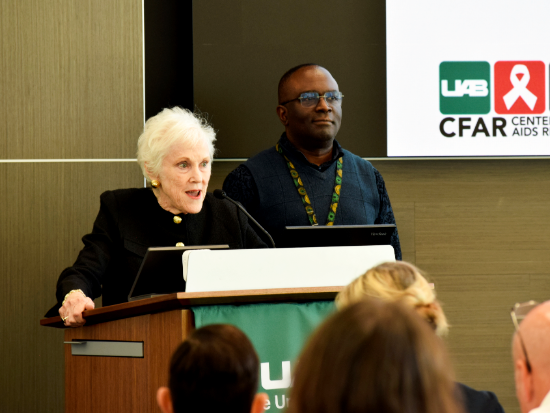 Philanthropic support is helping these opportunities grow. Among those in attendance was Gail H. Cassell, Ph.D., professor emeritus and former chair of the UAB Department of Microbiology, whose family’s $1 million gift established the Cassell Family Bidirectional Training Initiative within the Mary Heersink Institute for Global Health.
Through a partnership with Partners In Health’s Socios En Salud in Lima, Peru, the initiative provides reciprocal clinical training for UAB fellows and Peruvian physicians in two focus areas: post-tuberculosis lung disease and maternal-child health.
The connections that count
The day wrapped up with a Global Health Social Hour, where conversations sparked at the posters carried into a more relaxed setting among students, residents, fellows, faculty, and visiting experts. According to Netto, it’s moments like these that capture a side of global health education no textbook or lab can teach.
“As both a postdoctoral research fellow and an MSGH student at UAB, I see events like this as an important extension of our education,” said Netto. “They remind us that global health is not only about the research we conduct or the knowledge we acquire, but also about the connections we build, the perspectives we exchange, and the opportunities we create to make our work more meaningful and impactful.”
More than four decades after Saag arrived in Birmingham, the lectureship bearing his name carries forward the values that defined his career: collaboration, curiosity, and a commitment to the communities medicine serves. If this year’s event is any indication, the future of global health at UAB is in good hands.
To learn more about global health education and training opportunities, visit the Mary Heersink Institute for Global Health.