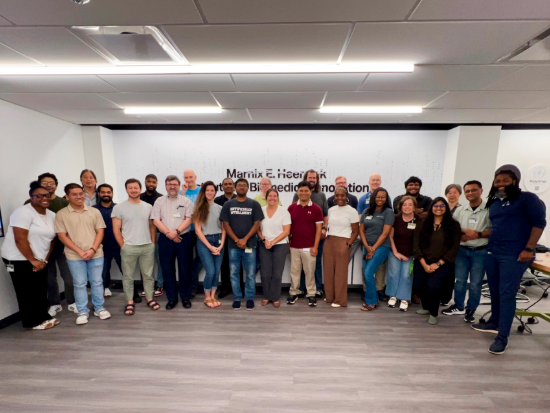
 Artificial intelligence is no longer a distant concept for health systems. It's already reshaping how clinicians document visits, how administrators manage scheduling, and how care teams navigate prior authorization and revenue cycle work. To help UAB’s clinical, administrative, and research professionals get ahead of that shift, the Marnix E. Heersink Institute for Biomedical Innovation hosted an intensive three-day workshop: AI Automation in Healthcare.
Held August 21–23, the roughly 15-hour, in-person intensive took participants on a hands-on journey from foundational AI literacy all the way to building working AI agents grounded in real healthcare workflows, with no engineering background required.
From literacy to launch
The workshop was structured to build skills progressively over three days.
Day one focused on foundations. Participants learned how large language models work, including their limitations related to hallucination, bias, and data sensitivity in clinical settings, before moving on to the CRAFT framework — Context, Role, Ask, Format, and Tweaks — for effective prompt engineering. The day closed with a guided, no-code build in Microsoft’s Copilot Chat Agent Builder, where each participant built their own AI assistant trained on sample healthcare material with any identifiable patient information removed.
Day two was all about building. Participants mapped out a real healthcare workflow, then turned it into an actual AI agent, starting with simple, no-code tools in Copilot Studio and working up to a coding agent built with the free, open-source OpenAI Codex CLI. By day's end, they had a more advanced agent capable of handling multi-step tasks, tested it on sample data, and recorded a short demo of it in action.
Day three rounded out the program with advanced and multi-agent frameworks, an introduction to the Model Context Protocol and on-device deployment with Ollama, and a critical session on governance, guardrails, and compliance — including how protected health information must move through UAB Health System's approval pathway before any tool goes live. The workshop closed with a cohort showcase, where participants presented their completed agents before receiving their certificates.
Every exercise relied on de-identified or synthetic data, and every tool used was free or already included in UAB's Microsoft license, removing cost and data-risk barriers for participants experimenting with the technology for the first time.
The workshop was led by Rubin Pillay, M.D., Ph.D., Sandeep Bodduluri, Ph.D., Heather Milam, and Abhi Pudhota of the Marnix E. Heersink Institute for Biomedical Innovation, with special guest faculty Anthony Chang, M.D., and Alfonso Limon, Ph.D., rounding out the teaching team.
Lessons from the workshop floor
For Mark Williams, M.D., vice president of the Learning Health System & Quality Improvement at UAB Medicine, what stood out most was the workshop's high faculty-to-student ratio, which has translated into continued collaboration.
“The workshop demonstrated how the partnership between clinicians with expertise and AI programmers is essential to build the AI agents needed to improve patient care at UAB Health System,” said Williams.
That collaboration, he added, points to where the technology is headed next.
“AI and automation will be essential to deliver high-quality, cost-effective care to patients and increase rapid access to patient education with confirmation of comprehension,” said Williams.
Jamie Wade, director of Outpatient Rehabilitation Service at UAB Medicine, pointed to two sessions that reshaped her thinking: the CRAFT model, which gave her a repeatable approach to prompting AI for better results, and the discussion of AI agents and their potential to streamline work and support decision-making.
“One of my biggest takeaways is how AI can serve as a practical tool to improve efficiency,” said Wade. “Since the workshop, I have been using it to reduce administrative workload, analyze complex data more quickly, and summarize themes and insights across a variety of projects.”
She sees that momentum continuing to build across her field.
"By automating routine tasks and simplifying data collection, they can provide more timely insights, support performance improvement efforts, and help teams make more informed decisions,” said Wade.
A model for practical AI adoption
What sets the workshop apart isn't just the curriculum, it's the emphasis on real-world application. Participants left with a working agent built around a genuine healthcare workflow, a governance and rollout plan for real-world use, and an ongoing connection to peers and faculty, turning a weekend of intensive training into sustained projects, sharper efficiency, and a clearer vision for how AI and automation will shape the future of healthcare delivery.