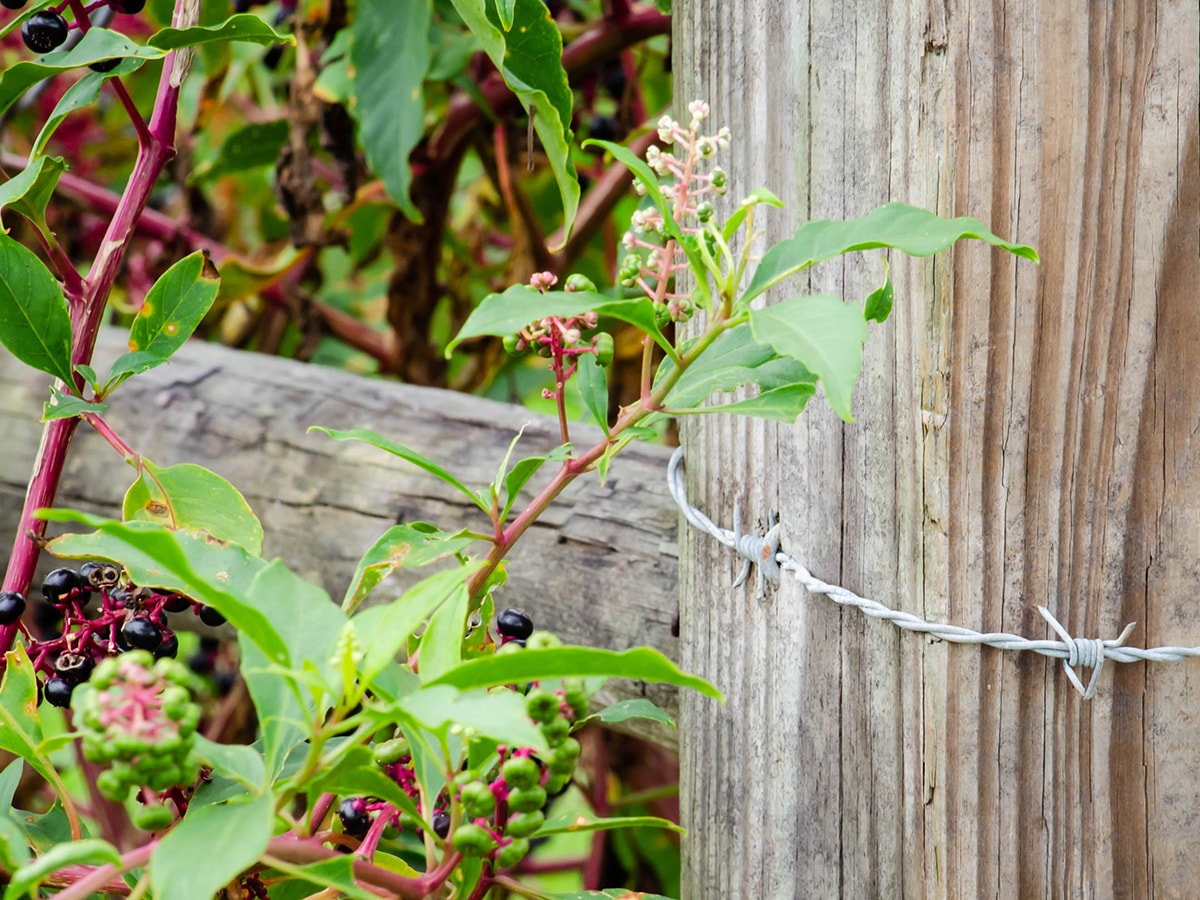
 Pokeweed, a hardy, poisonous member of the genus Phytolacca that can grow in tough environments, has the ability to remove rare earth elements from the soil.Rare earth elements are everywhere in the news today. That is because you need them to make smartphone screens, jet engines, MRI machines, electric vehicles, catalytic converters for non-electric vehicles, nuclear power plants and wind turbines, among many other high-tech products.
China produces about two-thirds of the world’s rare earths, a collection of 17 chemical elements that are mostly members of the lanthanide family. The United States is looking to find new sources — preferably domestic sources — to keep up.
The trouble is that the United States does not have many simple ways to access and refine the rare earth metals it has. “Rare earth elements are not really rare — they are just dispersed and distributed unevenly in the Earth’s crust because of tectonic processes. The U.S. has some resources, but its REE recovery lags behind China’s,” said Greer Dolby, Ph.D., assistant professor in the Department of Biology, part of the UAB College of Arts and Sciences.
Growing rare earth element production with weeds
But with a new grant from the Department of Energy’s Joint Genome Institute, Dolby and collaborators at North Carolina State University are exploring an intriguing way to ramp up domestic production of rare earth elements: weeds. Specifically, pokeweed, a hardy, poisonous member of the genus Phytolacca that can grow in tough environments, such as abandoned mines.
“Plants take up all kinds of metals and other elements that they use for different physiological reactions,” Dolby said. “Pokeweed can grow in pretty diverse settings and take up rare earth elements at an appreciable concentration.”
 Making pokeweed phytomining more efficient, and cost-effective, means figuring out which genes are responsible for extracting rare earths. That's where UAB's Greer Dolby, Ph.D., assistant professor in the Department of Biology, comes in.
Researchers who specialize in pokeweed, such as NC State’s Colleen Doherty, Ph.D., principal investigator for the new project, have documented how they can extract rare earth minerals from fly ash and acidified mine drainage sites. There are a number of these sites around the Southeast, including in Alabama, North Carolina and Georgia. Pokeweed could help reduce the environmental damage at these sites and bring the rare earth elements to the surface for harvesting, sparing the economic and environmental costs of digging them out. It is a concept called phytomining.
Improving pokeweed's phytomining potential
Making pokeweed phytomining more efficient, and cost-effective, means figuring out which genes are responsible for extracting rare earths. That is where Dolby comes in. She specializes in evolutionary genomics, particular in complex analyses of environmental impacts on genomes.
“Colleen told me that, when she was looking for someone to do this work, she put in a set of search terms in Google and I was the only one who came up,” Dolby said, laughing.
“This is an opportunity to re-mine using plants, from what is otherwise really garbage,” Dolby said. “And at the same time, you are revitalizing those environments. It is not often that something is economically viable and environmentally beneficial at the same time. In that case, you have to say yes.”
Dolby will start by mapping the genetic differences between pokeweeds that are highly efficient at taking up rare earths and those strains that don’t do it well at all. “A lot of the work I do is at a systems level, finding the genes that are involved in response to an environmental condition and which environmental parameters in particular are being responded to,” Dolby said.
As part of the project, the DOE’s Joint Genome Institute is building a reference genome for pokeweed, which has about 2 billion base pairs of DNA, compared with the 3 billion or so base pairs in humans. Dolby will take gene sequencing data from different pokeweed plants collected in the wild, compare them with the reference genome and identify the most important genetic contributors to rare earth extraction success.
The initial work should take about a year, Dolby estimates. The goal is that further funding would then move the research along to the point that it could become a marketable process. “The ultimate product would be a set of selectively bred lines that would probably each focus on certain rare earth element and specific growth conditions,” Dolby said.