What is Needs Assessment?
Needs assessment is the systematic process of gathering information and using it to determine instructional solutions to close the gap between what learners know and do and what learners should know and do. The fundamental premise is that, for education to be useful to the participants, it must close a gap or discrepancy between existing levels of knowledge, skill, competency, or attitude and a specific, desired level.
Here's an overview on addressing practice gaps from the ACCME:
The Standard
According to Joint Accreditation, Criterion 2 – The provider incorporates into IPCE activities the educational needs (knowledge, skills/strategy, or performance) that underlie the practice gaps of the healthcare team and/or the individual members’ knowledge, skills/strategy, or performance as members of the healthcare team.
The basics are simple: let's design our education events based on objectives that identify a specific need among the learner community, represented by an identified gap in knowledge:
Gaps:
- Knowledge - HCPs need new information
- Competence - HCPs need new strategies
- Performance - HCPs need to implement new strategies in their practice
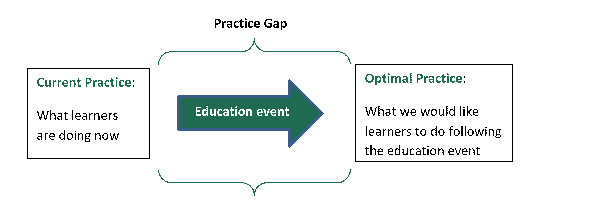
To satisfy the standard, we must document the methods and sources used to determine the specific educational needs to be addressed by any proposed activity, and this documentation must be based on evidence, i.e. it can include but can't rely entirely on faculty perception. Some independent evaluation must be conducted to verify the need, and document the presence of a gap.
- The essential process is one of collecting information to develop instruction that closes the gap between what a learner group knows (and does) vs. what the group should know (and do), i.e. the education is intended to bridge the gap between current actual and future desired practice
- So, ideally this happens prior to the development of any content
- The purpose is to identify and analyze a gap in knowledge, competence or performance, to serve as the basis for identifying relevant learning objectives that make the education event meaningful to the audience
- Sources of information can be categorized as (this is not an exhaustive list):
- Inferred needs: new methods of diagnosis or treatment that are not widely disseminated or used; new medications or indications; new technologies or regulatory requirements
- Perceived needs or interests: based on feedback, surveys, comments, or expert opinion
- Proven needs: quality data; epidemiological data; local/regional/national statistical data; professional society requirements; research literature
Sources of Information
Information on professional gaps can be obtained from within your division or department, from state and regional data, and/or from national data sources.
Local data will usually allow for a more targeted assessment of education needs, but might not always be available or accessible. State and regional data will be most appropriate for events that aim to educate physicians outside of UAB and within the extended physician community, and national data would be appropriate for events aimed at a national audience
Potential sources of information include:
| Local Sources | State\Regional Sources | National Sources | |
| Department/Division reports & statistics |
|
Institute for Healthcare Improvement | |
| Provider surveys | Regionalized CDC health data | Agency for Healthcare Research and Quality | |
| Participant feedback | ADPH Center for Health Statistics | National Guideline Clearinghouse | |
| Individual faculty analysis | Alabama public health statistics | Centers for Disease Control | |
| Analysis of aggregate data available through i2b2 | Centers for Medicare & Medicaid Services | ||
| National Committee on Quality Assurance | |||
| The Joint Commission |