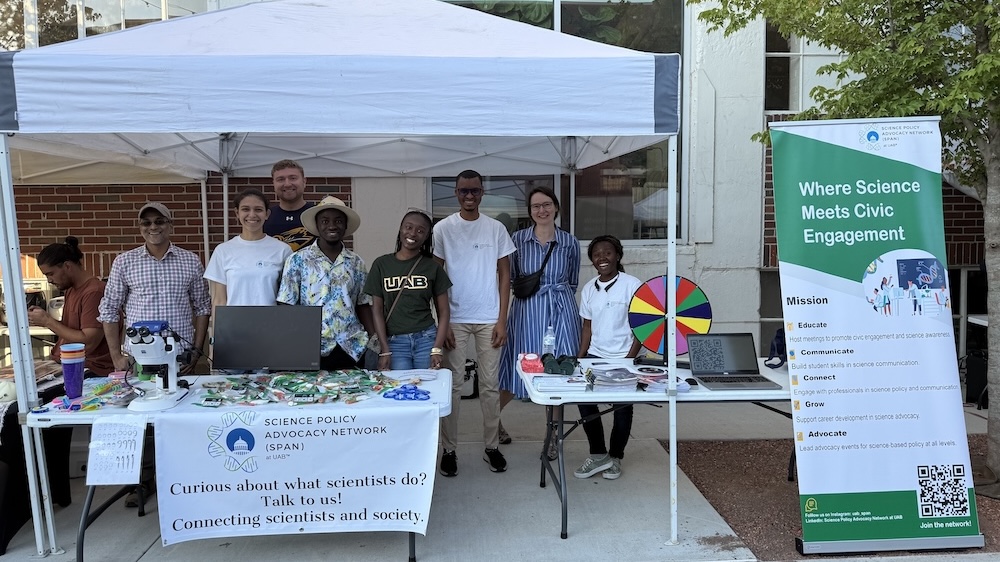
 Amanda Finn, 2nd from left, with SPAN at Pepper Place event.
She was a student researcher at an obesity conference, Obesity Week, in 2023. Dressed in her best suit, standing next to her research poster, she glanced out the conference center’s floor to ceiling windows. Just outside, she saw many unhoused people sleeping in tents.
It was that moment when something inside Amanda Finn broke.
“There was something unsettling about having your hotel room and meals paid for, but there are all these people who don’t have a home or reliable access to food,” said Finn, a student in the UAB PhD in Nutrition Sciences program. “I told myself I have to do science for the public. Morally – I just have to be out there and be more engaged with the public and not only other professionals.”
Running Start
Shortly after returning to Birmingham, Finn was on a run with a UAB friend talking about her experience and what it could mean for her future. The friend introduced her to another UAB doctoral student with a passion for science advocacy, Abubakar Sadik Mohammed.
They immediately hit it off. They immediately got started.
In 2024, they co-founded the Science Policy Advocacy Network (SPAN) at UAB as a student organization to enhance science policy skills among UAB trainees. Today, Finn is vice president and Mohammed is president.
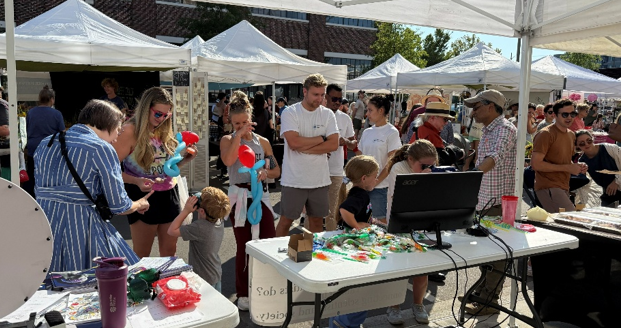
In 2025, they received a mini-grant from Research! America, a non-profit medical and health research advocacy alliance. This provided funds for their events, notably the science demonstrations at the Pepper Place Farmers’ market alongside the Neuroscience for All space of Kristina Visscher, Ph.D., associate professor in the UAB Department of Neurobiology, and the Saxena Lab of Ankur Saxena, Ph.D., associate professor, UAB Department of Cell, Developmental, and Integrative Biology.
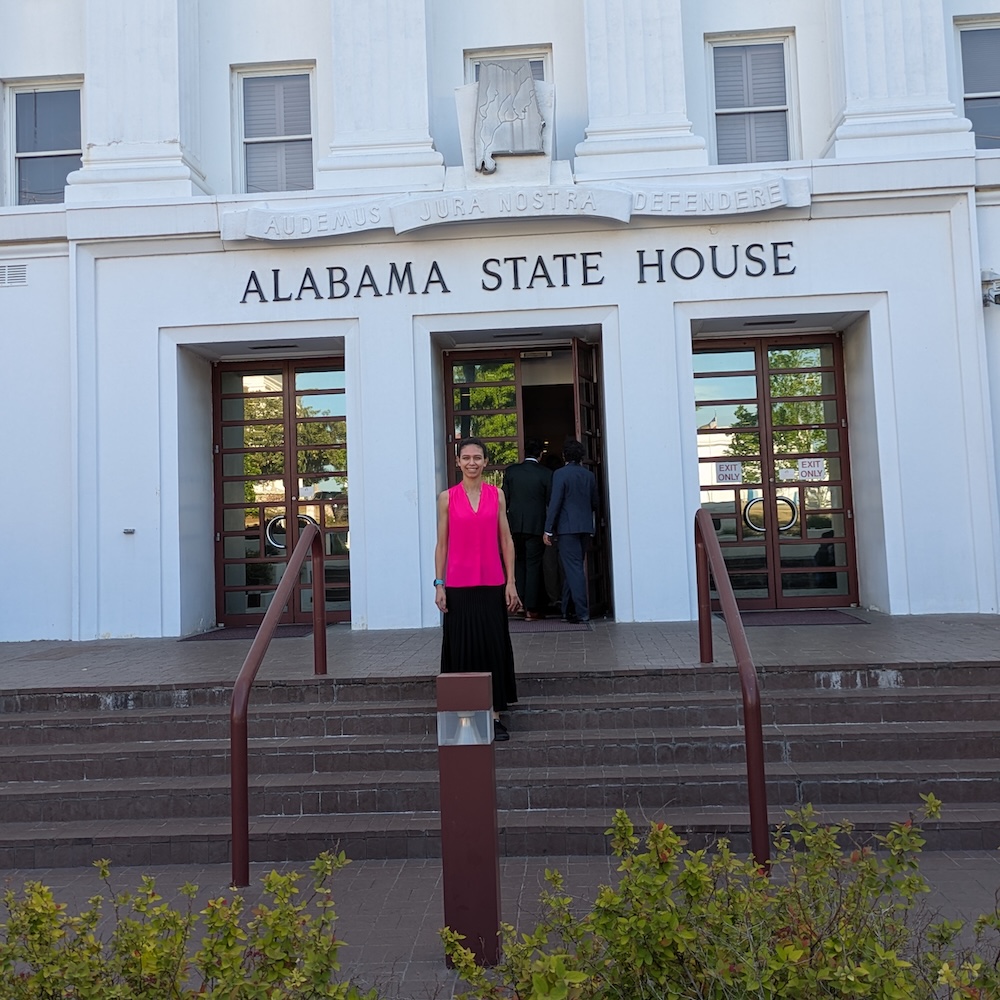
And in 2026, SPAN was awarded another mini-grant from Research! America, which allowed them to partner with the American Cancer Society (ACS) Cancer Action Network—and researchers around the state—to create the first ever Alabama State Capitol Cancer Research Symposium during the annual Cancer Action Day.
Alabama Research Symposium at Cancer Action Day
In 2025, Finn and Mohammed were inspired by Project Bridge Colorado, another science policy group, that held a STEM poster day inside the Colorado Capitol building. It was there that they had the idea to bring the actual research results directly to the Alabama policy makers with posters and presentations.
But how? The days the Legislature convene are irregular and the time for a meeting during a session is limited. And these are student organizers – not lobbyists.
“As a researcher, if you are also trying to advocate, it is very hard alone – it just is not feasible for one person on their own,” she said. “That is why we decided to collaborate with the American Cancer Society – they already have a relationship with the state house, and they already host this event annually, so they were able to help open the doors and connect us with policy makers.”
Saxena, who had partnered with SPAN for the Pepper Place event, connected Finn with Nicole Lallatin, the Tennessee and Alabama senior grassroots manager with the American Cancer Society Cancer Action Network. From there the Alabama Research Symposium at Cancer Action Day was born.
On March 31, more than 70 students from UAB, Alabama State University, Auburn University and the University of Alabama convened at the State Capitol in Montgomery, for this first-ever event. The students – ranging from undergraduates to post-doctoral trainees – presented posters and delivered 3-minute thesis talks for lawmakers and staff.
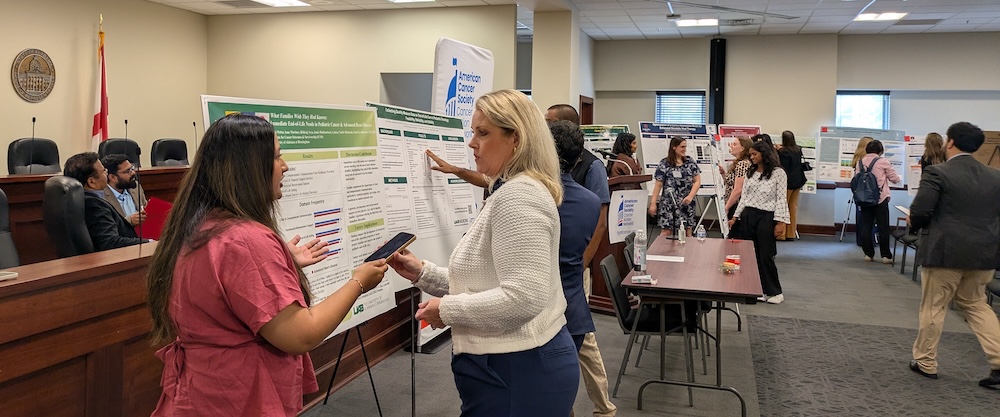
The SPAN officers handed out surveys for attendees to fill out during lunch at the event and of the 55 respondents, 54 wrote that the event “definitely should happen again next year.”
Some of the themes from the open-ended question about what the attendee learned at the event included cancer-related information (“Learned about community outreach for cancer screening through barber shops.”) and the importance of science advocacy (“I should use my voice and work to highlight the need for research.”). Several attendees also remarked on how this was a great networking event for cancer researchers to come together across the state.
Come Together and Talk to Each Other
At the start of the daylong event, the ACS gave an advocacy award to Alabama State Representative Frances Holk-Jones (R), District 95. She told the crowd that there are many ladies in the state house and senate who have battled breast cancer. She said cancer is personal: “No matter what your background is – a lot of people have cancer, and we need to come together.”
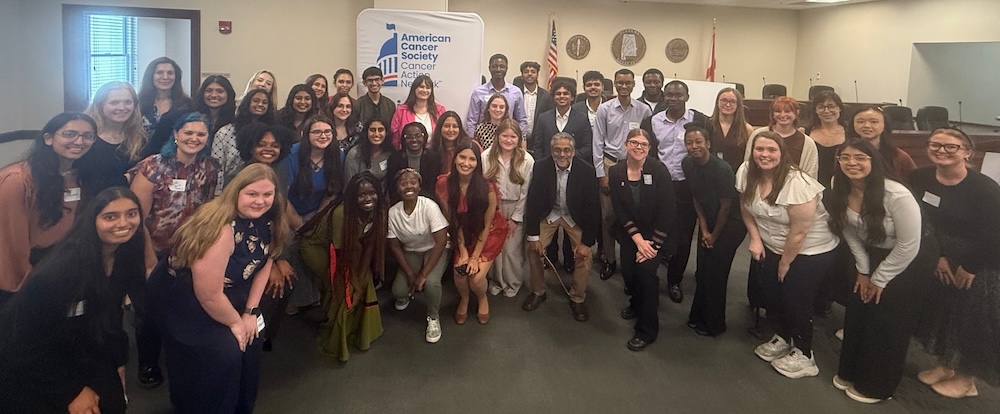
Finn has witnessed and participated in numerous scientific conferences and symposia. This event was a completely different experience. For example, this audience did not ask the presenters about the genetic background of their animal models. They wanted to know the background of the students themselves.
“The audience was more interested in the motivation behind the work and the successes. This was a really special event – it was very emotional.”
Part of that is because of Finn’s own background. Her mom passed away from cervical cancer when Amanda was only 17 years old.
Her decision to create this event was not a conscious choice because of her mom. After all, Finn conducts research in nutrition and obesity, not cancer. However, the more she talked to others, she realized it makes perfect sense that she would be so involved in research advocacy and cancer screening policy.
 In late 2025, she spoke with a staff member for Sen. Katie Britt (R-Ala.) about the importance of funding biomedical research and to her surprise, the staff member shared that she was a cancer survivor and really appreciated the science that goes into finding treatments. Finn shared the story of her mom with them. And that’s when it all hit home for her.
“Something I’ve learned in my advocacy is that people have their lived experiences and that is very powerful. It’s really important not to assume someone will not listen to you,” said Finn. “Until someone personally tells you ‘no’ – we have to talk to each other, because you won’t know what you have in common unless you talk to them.”
Finn is set to defend her dissertation for her PhD in Nutrition Sciences in July 2026. After her successful defense, she will begin a Rita Allen Foundation Civic Science Fellowship at Boston University’s Center for Media Innovation and Social Impact to increase our knowledge of how diverse stakeholders conceptualize and measure the social impact of research.
“I was raised in California, but I really grew up during my graduate studies in Alabama,” she said. “I will bring all the lessons I learned, within and outside the UAB walls, to my future work in Boston.”