Notice - Important SF424 Updates
- Details
- 2026-05-05 15:50
SOPs/Policies
Manuals
Worksheets
Checklists/Templates
Job Aids/Demo Videos
SOPs/Policies
Manuals
Worksheets
Checklists/Templates
Job Aids/Demo Videos
SOPs/Policies
Manuals
Worksheets
Checklists/Templates
Job Aids/Demo Videos
SOPs/Policies
Manuals
Worksheets
Checklists/Templates
Job Aids/Demo Videos
SOPs/Policies
Manuals
Worksheets
Checklists/Templates
Job Aids/Demo Videos

Scope:
Will be in **myUABResearch**
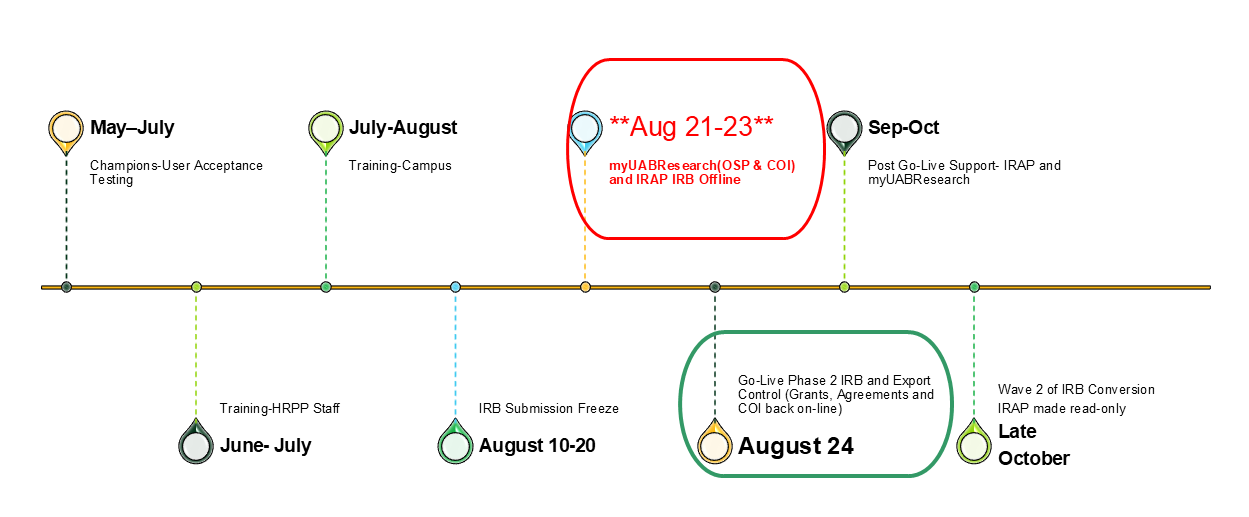
Timing: Converted at Go Live (August 24)
Scope:
Will remain in **IRAP**
Timing: Post Go Live (~6 weeks after launch) converted to myUABResearch
Do you have additional questions? Please visit our FAQs page for more information.
| Submission Type | Time-Sensitive Approvals – IRAP Submission Deadlines | Less Urgent – Consider Submitting in myUABResearch | Key Notes |
|---|---|---|---|
| Exempt / NHSR | Submit by late June / early July | Submit directly in myUABResearch on or after August 24 | Faster review (approximately 12–30 days median), but still allow buffer. |
| Expedited Studies | Submit by mid-June | Submit in myUABResearch on or after August 24 | Median review time approximately 40–80 days; build in revision cycles. |
| Full Board / Clinical Trials | Submit by late May to early June | Consider submitting after myUABResearch go-live unless urgent | Longest timelines (approximately 60–100+ days); high risk of missing Wave 1 if delayed. |
| Amendments (Procedural) | Submit by early to mid-July to ensure approval before August 20 | Avoid submitting just before Wave 2; otherwise submit after conversion in myUABResearch | Pending amendments will block conversion. |
| Personnel Amendments | Submit by late July (short review times) | Can wait and submit after August 24 if non-urgent | Typically quick (approximately 2–3 days median). |
| Continuing Reviews | See detailed table below | See detailed table below | Must be approved—not just submitted—to enable conversion. |
| Reportable Events | Submit as needed prior to August 10 | Allowed during freeze if urgent | Exception category. |
| Emergency Use / Just-in-Time (JIT) | Submit in IRAP and notify |
Submit via alternate process during freeze; upload after go-live | Exception category. |
| Protocol Expiration Date | Where to Submit CR | CR Submission Deadline | Rationale |
|---|---|---|---|
| Before October 12, 2026 | Submit in IRAP | Submit 6–8 weeks before expiration (approximately August 1 or earlier for early September expirations) | Must remain active in IRAP through Wave 2; cannot wait for myUABResearch. |
| August 10 – October 12, 2026 (high-risk period) | Submit in IRAP before August 10 | No later than August 8–9 | Avoid expiration during the freeze period and ensure study continuity. |
| After October 12, 2026 | Wait and submit in myUABResearch (if study converts) | Submit 6–8 weeks prior to expiration in the new system | These studies should convert in Wave 1 or Wave 2. |
| Late October–November 2026 Expirations | Prefer submitting after conversion in myUABResearch | Submit in the system where the study resides post-conversion | Avoid duplicate or conflicting submissions. |
| Not Converted by Wave 2 | Submit continuing review in IRAP if expiration is before October 1; otherwise follow new submission rules | Based on expiration timing | After Wave 2, IRAP becomes read-only; unconverted studies must restart. |
Last Modified: Oct. 13, 2025
The NSF HERD survey is the primary source of information on research and development (R&D) expenditures at higher education institutions in the United States and outlying areas. Over 900 universities and colleges complete the survey every year. UAB’s participation in this survey is very important because it helps the NSF produce the most accurate statistics possible on U.S. higher education R&D expenditures. Data for the HERD Survey is submitted via the NSF designated HERD website each Fiscal Year. The data is submitted by the Office of Research to NSF in January each year.
For examples of specific R&D disciplines, please see the listing below.
|
|
|
|
|
|
|
Use this category for R&D that involves at least one S&E field (categories A–H) if it is impossible to report multidisciplinary or interdisciplinary R&D expenditures in specific fields.
Also, use this category for R&D that involves multiple non-S&E fields if it is impossible to report multidisciplinary or interdisciplinary R&D expenditures in specific fields.
Professionals engaged in the conception or creation of new knowledge, products, processes, methods and systems and also in the management of the projects concerned. Include R&D managers in this category.
Persons whose main tasks require technical knowledge and experience in one or more fields of science or engineering, but who contribute to R&D by performing technical tasks such as computer programming, data analysis, ensuring accurate testing, operating lab equipment, and preparing and processing samples under the supervision of researchers.
Not directly involved with the conduct of a research project but support the researchers and technicians. These employees might include clerical staff, financial and personnel administrators, report writers, patent agents, safety trainers, equipment specialists, and other related employees.
Researchers contribute more to the creative aspects of R&D whereas technicians provide technical support. For example, a researcher would design an experiment, and a technician would run the experiment and assist in analyzing results.

Huron’s Huron Research Suite implementation approach is based on a methodology that includes all components of a successful system implementation of each module. Our methodology is organized into stages (Onboarding, Iteration, Test, Deploy and Support) that guide the order of the implementation work. Implementation threads (Project Management, Information Technology, Business Transformation and Delivery Management) are included in the work of each stage. Certain deliverables of each stage can be completed by Huron or the client affording flexibility in the resourcing model for the project.
Jump to a section...
The purpose of the onboarding stage is to provide the core project team, central office teams and departmental administrators with hands-on, in-depth training on the Huron Research Suite solution’s functionality and configuration capabilities. During these sessions, we will document feedback and identify gaps between your business processes and the Huron Research Suite solution. This will allow us to come to a mutually agreed upon scope for the configuration of the Huron Research Suite solution and align our business process with Huron' In parallel, key project management documents will be drafted and roles and responsibilities will be refined as necessary. Major decisions that will drive the direction of the project will also be determined (e.g., requirements definition, change leadership, and rollout strategy).
Key tasks in the Onboarding stage of the project include:
The Iteration stage consists of multiple cycles of detailing requirements, planning, configuring, process testing, and acceptance tasks. By completing this portion of the implementation in iterations, users are able to incorporate adjustments made in early iterations with future iterations in a more effective and cost-efficient manner.
Key tasks in this stage include:
The key objectives of the Test stage are to pilot “future state” business processes in the new system and to verify that all components are working as designed to support the Client’s implementation goals.
Key tasks in this stage include:
The objective of the Deploy stage is to successfully transition the new system to the end-user community.
Key tasks in this stage include:
During the new system’s stabilization period, the Huron team will work to transition all project roles and responsibilities to the Client team.
Key tasks in this stage include: