In response to significant changes in federal policy that affected research funding and other areas, Heersink School of Medicine and UAB leaders took swift and direct action to strengthen continuity and stability for our faculty and staff and support our missions. This included advocating directly with congressional and other government leaders, in Washington, D.C., and on our campus.
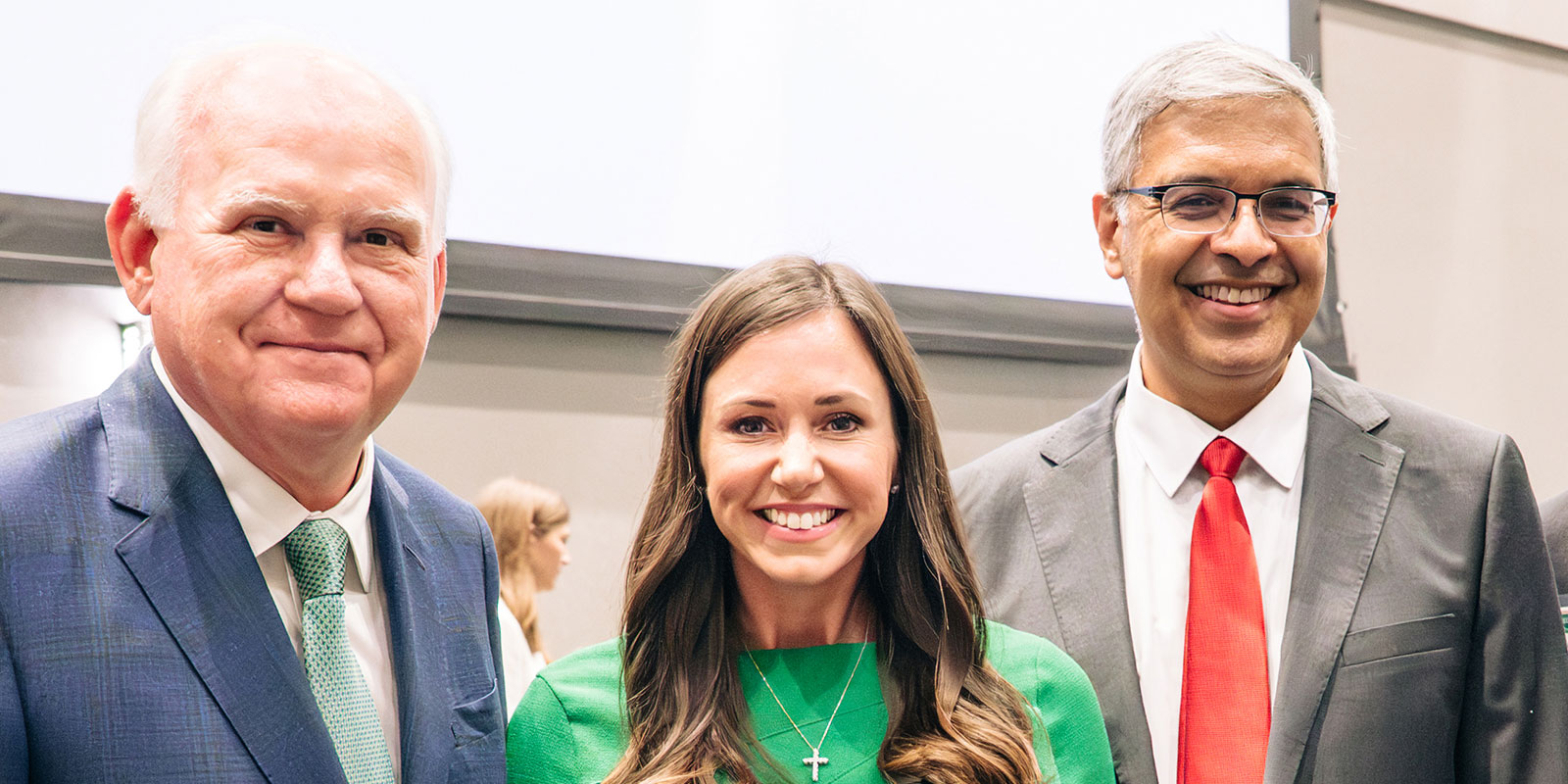
UAB welcomed National Institutes of Health (NIH) Director Jay Bhattacharya, M.D., Ph.D., and U.S. Senator Katie Britt on August 14, 2025, who spoke before a standing-room-only audience. Bhattacharya discussed some of the NIH’s goals over the next few years, including finding a cure for HIV, and highlighted UAB’s importance in the NIH mission. “One of the main reasons why it’s so important that places like UAB exist … is that the research infrastructure of this country must reflect the people of this country,” Bhattacharya said.
Bhattacharya is the third consecutive NIH director to visit UAB: Frances Collins, M.D., Ph.D., visited March 6, 2020, and Monica Bertagnolli, M.D., visited March 4, 2024.
Britt returned to Heersink on September 26 along with U.S. Senator Shelley Moore Capito of West Virginia, chair of the Senate Appropriations Subcommittee on Labor, Health, and Human Services, to meet with research leaders from across the school. Britt and Capito were presented with the UAB O’Neal Comprehensive Cancer Center’s Iron Strong medals for their efforts to secure funding that keeps vital research moving forward to benefit patients at UAB and across the U.S.
Heersink School of Medicine Senior Vice President for Medicine and Dean Anupam Agarwal, M.D., was invited to participate in the Joint Associations Group (JAG) on Indirect Costs’ Subject Matter Experts (SME) Team. JAG is a group of national organizations representing America’s academic, medical, and independent research institutions that came together to develop a more efficient and transparent model for funding indirect costs, also called facilities and administrative (F&A) costs, on federal research grants.
Indirect costs are the essential institutional costs associated with conducting federally funded research. Examples include building and facility maintenance; support for the preparation, submission, and financial management of grant proposals and awards; funding for human resources, payroll, acquisition, and essential utilities and space upkeep; secure data storage and high-speed data processing; and more.
In a July 11, 2025, statement, JAG released its recommendation to Congress and the executive branch for a new model to replace the current facilities and administrative (F&A) cost structure. The Financial Accountability in Research (FAIR) model seeks to reduce confusion and misunderstanding, promote transparency, and improve efficiency in the calculation and disbursement of indirect costs.
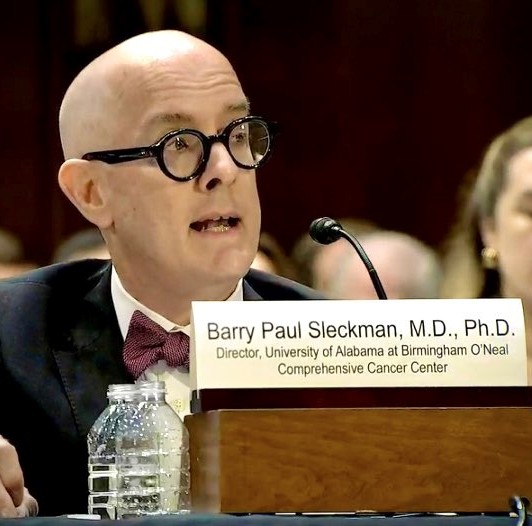 UAB O’Neal Comprehensive Cancer Center Director Barry Sleckman, M.D., Ph.D., testified before the U.S. Senate Appropriations Committee hearing, “Biomedical Research: Keeping America's Edge in Innovation,” on April 30, 2025. Sleckman spoke eloquently about the essential role of federal support in funding clinical trials and research, which have saved countless lives and extended survival for many cancer patients. He noted that these investments have led to a 34 percent reduction in cancer mortality over the past 30 years and an increase in cancer survivors in the U.S. from 8 million in 2000 to 18 million in 2022, with a predicted 26 million survivors by 2040. Importantly, he emphasized that “the advances in virtually all other chronic and acute illnesses have been equally remarkable, and all because of federal investments in biomedical research.”
Live HealthSmart Alabama (LHSA) Chief Executive Officer, Mona Fouad, M.D., MPH, and Chief Administrative Officer, Teresa Shufflebarger, represented UAB as one of only eight institutions at the Association of American Medical Colleges (AAMC) Congressional Reception in Washington, D.C., June 24-25, 2025.
LHSA was invited to attend to highlight the role of academic medicine in advancing community health. While in D.C., they met with Alabama legislators to discuss LHSA’s impact across the state.
Other actions taken by the school include:
- Monitoring Heersink grant trends closely and coordinating grant appeals with the UAB Office of Research
- Launched a Refresh Committee to ensure our Research Strategic Plan aligns with current and future federal funding priorities and identify potential new areas of opportunity
- Launched a new bridge funding mechanism designed to support investigators whose proposals have received a “fundable score” but await the Advisory Council meeting
- Regular and transparent communication with Heersink departments, faculty, and staff, including six Heersink Office of Research Town Halls
- Creating a research policy updates webpage and collaborating with centers and Institutes on workshops to address policy changes in grant proposals
- Renewed focus on financial sustainability and optimizing processes and infrastructure to strengthen long-term positioning
- Introduced the new REFRESH Award, a short-term funding mechanism designed to support Heersink faculty whose research programs have experienced an unanticipated loss of funding.